Produced in May 2010, the Scenarios for the Future of Technology and International Development report (Downloadable PDF at the bottom of the page) presents itself as a scenario planner that outlines four potential futures with a focus on how Technology and Philanthropy, in particular, can be used in each of them. The four scenarios are formed using two “uncertainties” that, in the Foundations’ view, underpin how a society operates and, ultimately, what scenario would emerge. The uncertainties are “Political and Economic Alignment” and “Adaptive Capacity” and it presents them as converging spectrums that ultimately create a matrix where four distinct scenarios emerge.
See figure 1 below below:
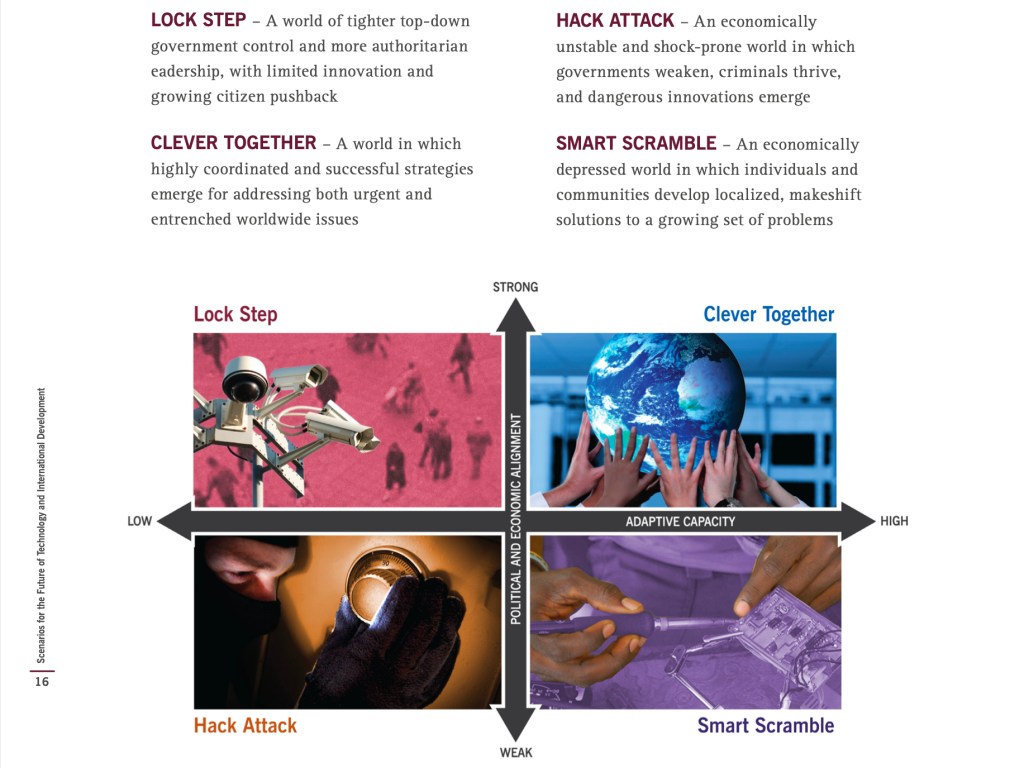
The scenarios of most intrigue in particular are Lock step and Clever Together. As this article will highlight, Lock step matches almost precisely what occurred during the COVID-19 Pandemic for most of the nations of the world even down to the minute details, bar a few exceptions – Sweden as a prime example (this will be discussed later in the article).
Lock Step sets the scene with a global pandemic that “the world had been anticipating for years”. Already, consider how Bill Gates has been “warning” the world for years of a coming pandemic, such as during his famous TED Talk on the matter, and notice the resemblance right from the beginning. Bill even indicates that the next pandemic could be a “bioweapon” and that carriers of the disease could “feel well enough while they’re infectious that they go on a plane or go to a market.”
The scenario goes on to outline how the virus spread rapidly, infecting “nearly 20 per cent of the global population and killing 8 million in just seven months, the majority of them healthy young adults.”
John Hopkins Medicine reported on this in December 2020, quoting a Centers for Disease Control (CDC) study that stated,
“Over the summer, in the United States, people under age 30 accounted for more than 20% of COVID-19 cases and were seen as more likely to transmit the virus than others. This trend has continued into the fall.”
The similarities get stronger as it goes on to say,
“the pandemic also had a deadly effect on economies: international mobility of both people and goods screeched to a halt, debilitating industries like tourism and breaking global supply chains. Even locally, normally bustling shops and office buildings sat empty for months, devoid of both employees and customers.”
Despite huge worldwide disruptions, some countries did better than others apparently – “China in particular”.
“The Chinese Government’s quick imposition and enforcement of mandatory quarantine for all citizens, as well as its instant and near hermetic sealing off of all borders, saved millions of lives, stopping the spread of the virus far earlier than in other countries and enabling a swifter post-pandemic recovery.”
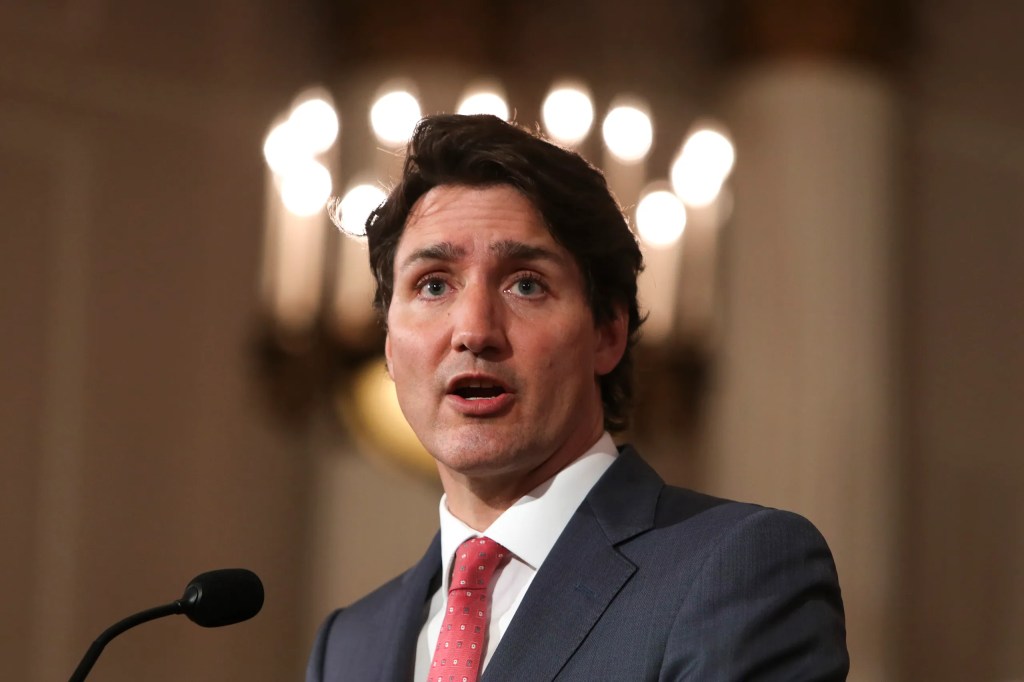
Image extracted from The New Yorker
This Authoritarian description is seen as favourable to Current Globalist World Leaders such as Canadian Prime Minister Justin Trudeau who said,
“There is a level of admiration I actually have for China because their basic dictatorship is allowing them to actually turn their economy around on a dime and say we need to go green, we need to start, you know, investing in solar… There is a flexibility that I know [Prime Minister] Stephen Harper must dream about: having a dictatorship where you can do whatever you wanted, that I find quite interesting.”
World Economic Forum Leader, Klaus Schwab, holds the same sentiment and admiration as Trudeau for China’s dictatorship too.
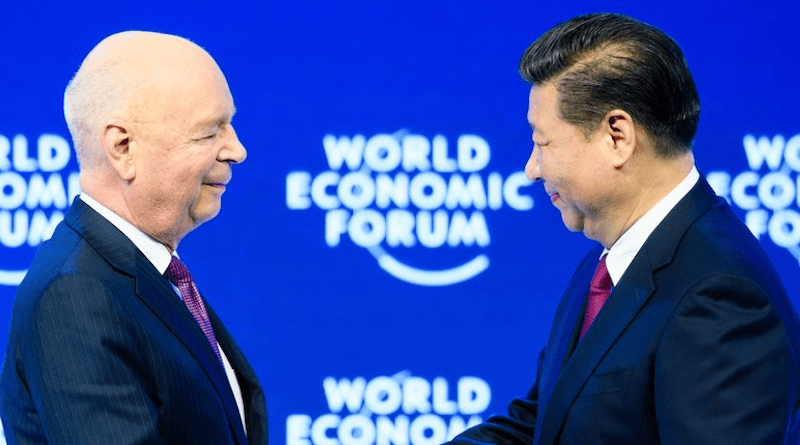
Image extracted from Eurasia Review.
“Premier Li took his office this March at China’s National People’s Congress at a critical moment when China adopted new COVID control measures and started to boost economic development, social dynamism, and international cooperation”.
It’s worth noting that Justin Trudeau is a graduate of the World Economic Forum’s Young Global Leaders, so it’s perhaps unsurprising that he upholds the same views as the program’s leader, Professor Schwab.
Lock Step continues to highlight more and more similarities with the COVID situation and even scarily asserts,
“National Leaders around the world flexed their authority and imposed airtight rules and restrictions, from the mandatory wearing of face masks to body-temperature checks at entries to communal spaces like train stations and supermarkets. Even after the pandemic faded, this more authoritarian control and oversight of citizens and their activities stuck and even intensified.”
Prime Minister Trudeau also happens to be a very good example of this, when in 2022 he invoked the Emergencies Act in response to the Peaceful Canadian Trucker Protests. This enabled him to freeze the bank accounts of those involved and imprison them too, putting them, by implication, in the same category as a terrorist organisation.
Lock Step outlines the public response to the pandemic which is, yet again, eerily similar to the COVID situation.
“At first, the notion of a more controlled world gained wide acceptance and approval. Citizens willingly gave up some of their sovereignty—and their privacy—to more paternalistic states in exchange for greater safety and stability. Citizens were more tolerant, and even eager, for top-down direction and oversight, and national leaders had more latitude to impose order in the ways they saw fit. In developed countries, this heightened oversight took many forms: biometric IDs for all citizens, for example, and tighter regulation of key industries whose stability was deemed vital to national interests.”
Nearly all of this could be seen in Australia’s situation. Many citizens were certainly not only tolerant of, but often advocates for, the harsh measures taken by Queensland Premier Annastacia Palaszczuk, for example.
An ABC Article from 2021 stated,
“The ease with which WA Premier Mark McGowan and Queensland Premier Annastacia Palaszczuk were re-elected off the back of strict approaches to keeping COVID out of their states — especially through closed borders — shows that most of the public have been strongly in favour of strong measures to get to zero COVID.”
Now looking back at the layout of the 4 scenarios within the Rockefeller Document, some very interesting observations can be made.
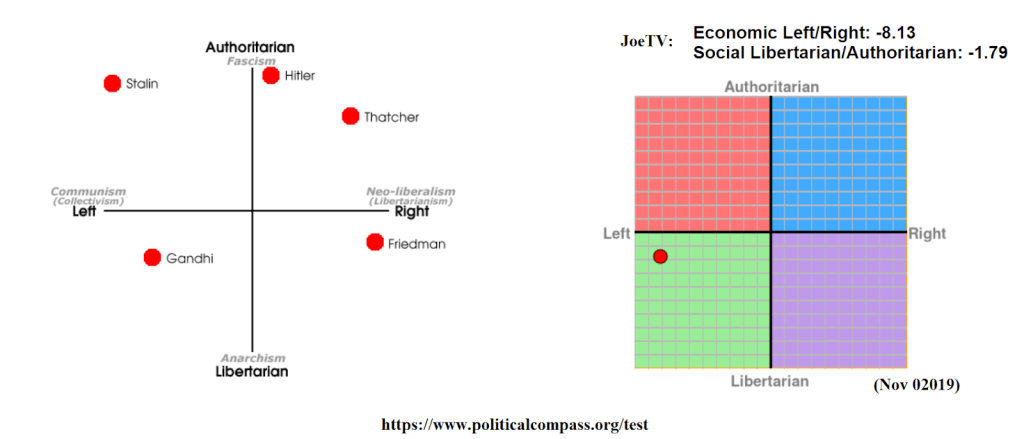
Figure 2 above displays a very similar matrix to figure 1 with two converging values that ultimately create 4 distinct sectors. In this matrix, the vertical axis represents Authoritarian Government at the top to Libertarian Government at the bottom whereas the horizontal axis represents left to right wing economic ideology.
Despite the label differences between figure 1 and 2, upon closer inspection, the seemingly different terminologies actually equate to the same thing.
The “Political and Economic Alignment” value from figure 1 is plotted in the same way as the “Authoritarian” to “Libertarian” value in figure 2 and the corresponding scenarios – Lock Step and Clever Together – clearly depict Authoritarian regimes. The remaining two scenarios – Hack Attack and Smart Scramble – placed on the bottom sector of Figure 1 also inversely depict “Libertarian” Government. It is recommended that the reader reads through Hack Attack and Smart Scramble for context of this.
Upon analysing Lock Step and Clever Together, we see that the only difference between the two lies in the public’s response and cooperation, which represents the horizontal X-axis of both figures.
In Lock Step, there is public resistance brewing due to distrust of the Authoritarian Government with its harsh surveillance, actions, and policies, therefore placing it on the left of the graph. Clever Together depicts a world where the citizens embrace the increasing power of centralised Authorities and Philanthropic organisations, pushing it to the right of the graph. It’s ultimately demonstrating what could be argued as a “left wing” vs “right wing” approach to the same fundamental setup.
In Clever Together,
“Nation-states lost some of their power and importance as global architecture strengthened and regional governance structures emerged. International oversight entities like the UN took on new levels of authority, as did regional systems like the Association of Southeast Asian Nations (ASEAN), the New Partnership for Africa’s Development (NEPAD), and the Asian Development Bank (ADB).”
Despite this, Clever Together’s scenario paints itself as an exceedingly greater prospective future than the other which becomes extremely apparent as one reads the whole scenario.
Given that the two “Libertarian” scenarios are depicted quite unfavourably, the underlying premise of the report could be: Authoritarianism is the way forward and in the face of a pandemic, Lock Step would be the likely default scenario.
This assertion, however, stands in contradiction to what can be observed from certain nations’ pandemic response – Sweden in particular.
A Study by The CATO Institute found the following,
“During the COVID-19 pandemic, Sweden stood out from other countries, stubbornly refusing lockdowns, school closures, and mask mandates. This was highly controversial and many outsiders saw it as a dangerous gamble with human lives.”
But it turns out that Sweden was actually following a developed pre-pandemic plan from the World Health Organisation (WHO) itself that most nations of the world discarded in favour of a more Lock Step approach once COVID-19 emerged.
The CATO Study continues,

“For decades the World Health Organization had planned for a pandemic, and lockdowns of entire societies were never part of the discussion. Instead, plans focused on protecting the most vulnerable but trying to keep society as a whole up and running. What set Sweden apart was that it stuck to that plan, and from a Swedish perspective, it looked like it was the rest of the world that was engaging in a risky, unprecedented experiment.”
It also turns out that the results of this were extremely positive for Sweden across many fronts.
A publication from Reason.com stated,
“Swedish students suffered no learning loss during the pandemic, whereas half of U.S. students did. The country’s economic growth outperformed the eurozone and the United States. It avoided other countries’ increased suicide rates and deteriorated mental health.”
What’s of even further surprise to many is the Swedish COVID death figures, or lack thereof.
According to Statistics produced by John Hopkins University, Sweden didn’t even make the top 20 for deaths proportionate to their “COVID cases or population”.
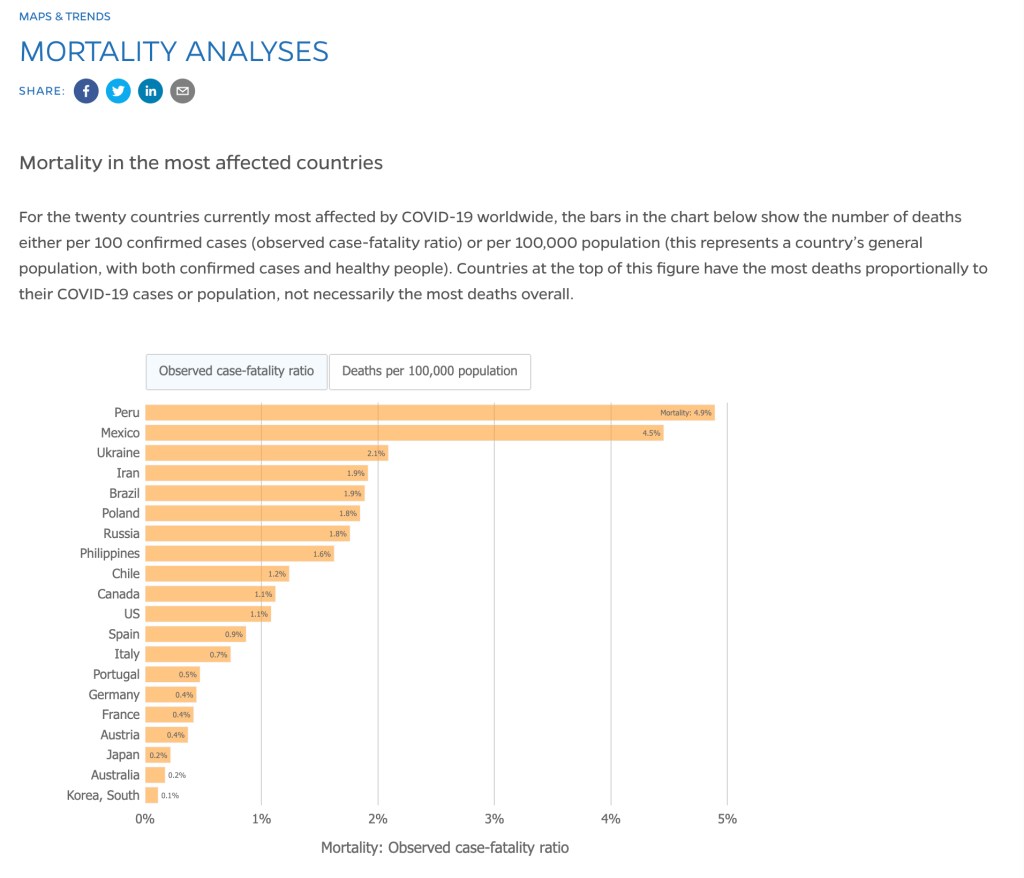
This means that Sweden experienced less proportionate deaths to their population and COVID case numbers than many countries who opted to follow a more Lock Step style of Pandemic Response.
But this also does not factor in the studies that found Sweden’s record of COVID deaths may have been over counted, meaning there was potentially a great number of deaths that were officially recorded as “COVID Deaths” where COVID was not the actual cause of death.

Image extracted from Tedros’s Twitter Profile
With all of the above considered, what can be said about the Rockefeller Foundation Report could probably fill another dozen articles on top of this one, but what arises for me, personally, first and foremost is a consideration followed by a question.
Consider this: The Rockefeller Foundation is one of the key Philanthropic Organisations working in collaboration with the World Economic Forum (WEF) and The WHO.
The WHO Website makes this perfectly clear,
“The Rockefeller Foundation-WHO collaboration goes back to the beginnings of the World Health Organization… The Rockefeller Foundation and WHO can point to several joint successes in addressing global health challenges through the advancement of medical science, data, and innovation to improve equitable health outcomes for all.”
It’s almost certain, therefore, that the Rockefeller Foundation was well aware of the WHO Pre-Pandemic Plan that Sweden ultimately followed.
Why then, would the hypothetical future scenario of a pandemic contained in a report produced in 2010 not include the scenario that Sweden displayed in accordance with the WHO plan, but instead outlined a scenario that went completely against the WHO plan and that happened to detail almost precisely what occurred during the COVID-19 pandemic?
Bear in mind that the report labels Lock Step as “plausible” and as a glimpse of “what the future might look and feel like” despite, again, the official plan of action being completely contrary to it.
Was Lock Step a hypothetical scenario or a plan that has now been executed?



 Your Truth Seeker
Leave a comment